> For the complete documentation index, see [llms.txt](https://docs.coin98.com/llms.txt). Markdown versions of documentation pages are available by appending `.md` to page URLs; this page is available as [Markdown](https://docs.coin98.com/products/coin98-super-wallet/mobile/social-wallet/how-to-restore-a-social-wallet-1.md).
# How to restore a Social Wallet logged via Email
Since Google and Email login options are now unified, if your email has never been used to log in to Coin98 before, logging in with either option will create the same new wallet
However, if you have previously logged in using the Email option with that email address
* Logging in with Google will create a new wallet linked to your Google account.
* Logging in with Email will restore your previous wallet associated with the Email login.
To access your previous wallet created via Email login, please follow the instructions below.
## The first way: via Social Wallet
**Step 1**: At the top right corner of the home page, choose **Add Wallet** icon
**Step 2:** Click **Create a New Wallet** or **Add an Existing Wallet,** then select the **Social Wallet** option
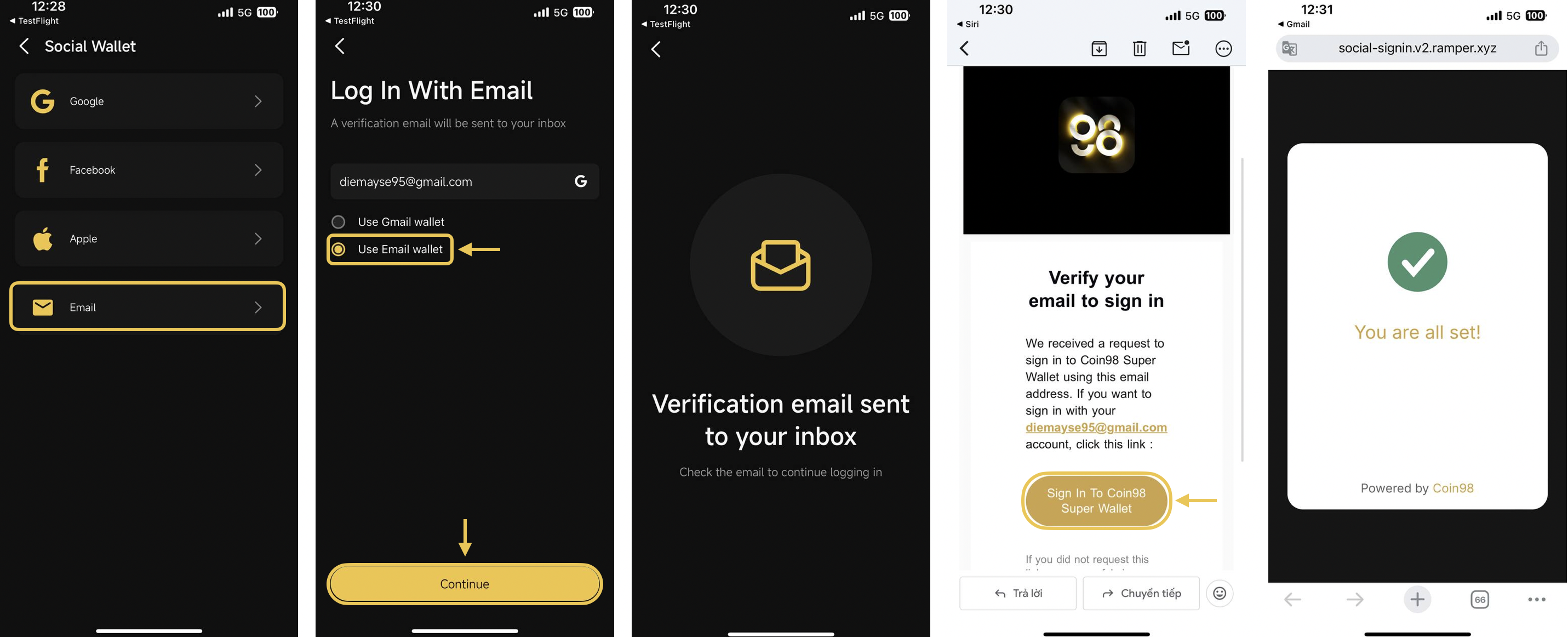
**Step 3**: Choose **Email** option
**Step 4:** Enter the email address associated with the wallet you want to restore.
After you enter your email, the Coin98 Super Wallet will check its login history. If this email was previously used to log in via the Email option, the app will display two login methods:
1. **Use Gmail Wallet**
2. **Use** **Email Wallet**.
To restore your previous wallet, please select the **Use** **Email Wallet** option.
**Step 5:** Check your email and complete the required verification steps.
Once you see the message **You're all set**, return to the app, and your restored wallet will appear on the main screen.
## The second way: via recovery keys
If you wish to restore a social wallet from another party such as Ramper Wallet into Coin98 Super Wallet, you will need to import the wallet in the same manner as a Hot Wallet, **using the Seed phrase or Private key**.
You can refer to the document below for more detailed instructions on how to restore a wallet with its Seed Phrase
{% content-ref url="/pages/RXBc5EkpsJZssDTIc6Nm" %}
[How to import Multi-chain wallets to Coin98 Super Wallet](https://docs.coin98.com/products/coin98-super-wallet/mobile/wallet-management/v15-how-to-import-multi-chain-wallets-to-coin98-super-wallet.md)
{% endcontent-ref %}
---
# Agent Instructions
This documentation is published with GitBook. GitBook is the documentation platform designed so that both humans and AI agents can read, navigate, and reason over technical content effectively. Learn more at gitbook.com.
## Querying This Documentation
If you need additional information that is not directly available in this page, you can query the documentation by asking a question.
Perform an HTTP GET request on the following URL with the `ask` and `goal` query parameters:
```
GET https://docs.coin98.com/products/coin98-super-wallet/mobile/social-wallet/how-to-restore-a-social-wallet-1.md?ask=&goal=
```
`ask` is the immediate question: it should be specific, self-contained, and written in natural language.
`goal` is what the user is ultimately trying to achieve, the reason they need the answer. Sharing it helps GitBook give you a better, more relevant answer. A goal is most helpful when it describes the outcome the user wants rather than restating the question. For example, with `ask=how do I create an API token`, a goal like `automate deployments from our CI pipeline` lets GitBook tailor the answer to that use case.
The response will contain a direct answer to the question and relevant excerpts and sources from the documentation.
Use this mechanism when the answer is not explicitly present in the current page, you need clarification or additional context, or you want to retrieve related documentation sections.